
 Home
Home About
About Product
 News
News  Media channels
 Guide
GuideTax refund in Japan is a legal right that many people still do not know how to take advantage of properly. Understanding the personal income tax refund procedure in Japan will help you save significantly, especially in cases where you have dependents in Vietnam or have just quit your job or changed jobs. This article will explain to you from the concept to the documents required to apply for a tax refund in Japan, how to carry out the 5 steps of filing the application and important notes to ensure the tax refund is smooth, valid and effective.
General information about tax refund in Japan
When living and working in Japan, every individual with income must fulfill their tax obligations according to government regulations. However, not all taxes paid are lost. In many cases, you can completely request a refund of a portion of the tax paid - called a tax refund in Japan (還付申告 - kanpu shinkoku).
What is tax refund in Japan?
Tax refund in Japan is the process of re-declaring your income and related expenses to determine the actual amount of tax you paid during the year. If the amount has been over-deducted, you have the right to request the Tax Office to refund the excess to your bank account.
Typically, this process takes place through the year-end tax settlement, known as 確定申告 (kakutei shinkoku). This tax declaration can be made by workers, international students, or trainees, depending on the specific situation.
Understanding and proactively implementing tax refunds brings many practical benefits, especially for Vietnamese people who have just arrived in Japan:
- Personal financial savings: You can get back several tens of thousands to hundreds of thousands of yen per year.
- Legalization of rights: Helps you comply with tax laws and avoid future problems.
- Tax optimization through dependents: If you provide for relatives in Vietnam, you can declare dependent deduction to get more back.
Cases of tax refund in Japan
Not everyone needs or is allowed to get a tax refund, but if you fall into one of the following categories, you can absolutely apply for a personal income tax refund in Japan to get back the amount of tax that was unnecessarily deducted:
- People with income below taxable level: If your annual income is less than 1.030.000 yen but you still have tax deducted, you can apply for a full refund of the tax you paid.
- People with dependents in Vietnam: If you send support money to a parent, spouse or child who has no income, you can claim a dependent refund to reduce your taxable income.
- Mid-year leaver: When you quit your job but do not do the year-end settlement with the company, taxes may have been over-deducted and you need to self-declare to request a refund.
- People who change jobs multiple times a year: If you work for multiple companies, taxes are calculated separately which can lead to overpayments – you need to consolidate your income and re-file.
- Part-time work for international students is unstable.: Even though your income is low, many people still have their taxes deducted because the company defaults to applying the standard tax rate. This is the group that should get an annual tax refund.
- Tax deductible person even though not subject to tax: This often happens if you have not submitted insurance deduction documents, dependents, etc. in time, leading to incorrect deductions that need to be adjusted by filing a tax refund.
- People with high medical expenses or paying for life insurance or retirement: You can claim additional eligible expenses to reduce your taxes, which means you get more money back.
- People returning home but have not yet settled taxes: Even if you have returned to Vietnam, you can still ask relatives or tax declaration services in Japan to request a refund of the remaining amount.
Documents needed to apply for tax refund in Japan
To complete the personal income tax refund procedure in Japan, you need to prepare the following documents. The more complete and transparent the documents are, the faster the review and refund will be.
Basic documents
Basic documents for tax refund application in Japan applicable to all subjects include:
- Gensen Choshuhyo (源泉徴収票) – Certificate of income and tax deducted: Issued by the company at the end of the year or upon leaving the job.
- My Number Card or My Number confirmation certificate (個人番号通知書): Personal identification number used for tax and social security management.
- Zairyu Card (在留カード) – Valid residence card: Photocopy of both sides of the card, used to verify residency status.
- Passport: Copy of page with photo and personal information.
- Bank book or ATM card: Bank account in Japan to receive tax refund (with photo of name + account number).
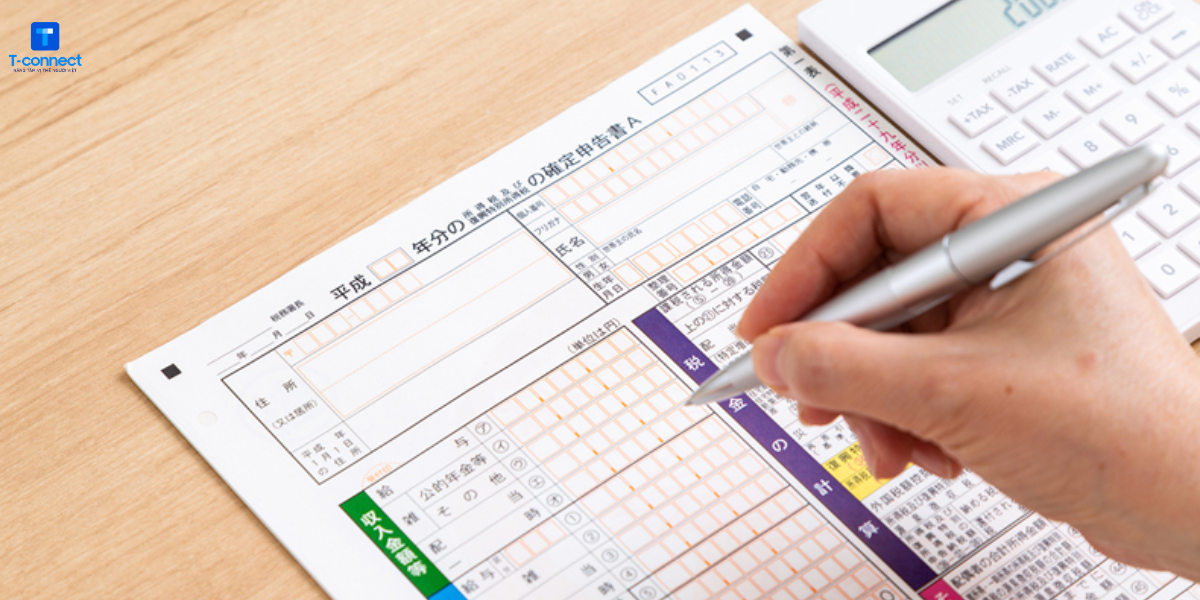
- Kakutei Shinkoku Tax Return (確定申告書): Tax return form, can be filled out online or by hand. You can download it at here.
For international students, you only need to prepare the following documents:
- Gensen (源泉徴収票): Income tax certificate.
- Bank book: To get a tax refund.
- Residence card and identification documents: To verify identity.
Additional documents (if declaring dependents in Vietnam)
To apply for a dependent tax refund, you need to prepare the following additional documents (it is best to have them translated into Japanese and notarized):
- Birth certificate or proof of relationshipFor example: birth certificate, marriage certificate, family register...
- Certificate of dependents with no income in Vietnam: Confirmed by local authorities in Vietnam.
- Documents for money transfer to Vietnam: Can be an international money transfer receipt (sent via bank, konbini, Western Union…), bank account statement, or transfer confirmation.
- Proof that the dependent is the sole recipient of financial support from you (if required): In some cases, the Tax Authority may request additional confirmation.
5-step guide to personal income tax refund in Japan
Tax refunds can be done by yourself, without the need for a service, if you know the process. Here is the tax refund procedure in Japan with 5 simple steps:
Step 1: Prepare all necessary documents
First, check the documents required for tax refund in Japan as mentioned above:
- Gensen Choshuhyo (certificate of income & tax deducted).
- My Number, Zairyu Card, passport.
- Bank book to receive refund.
- Kakutei Shinkoku Tax Return,.
- Documents proving dependents (if declared).
- Money transfer receipt (if dependent in Vietnam).
You should arrange your documents in a logical, easy-to-check order, and keep copies available in case of need.
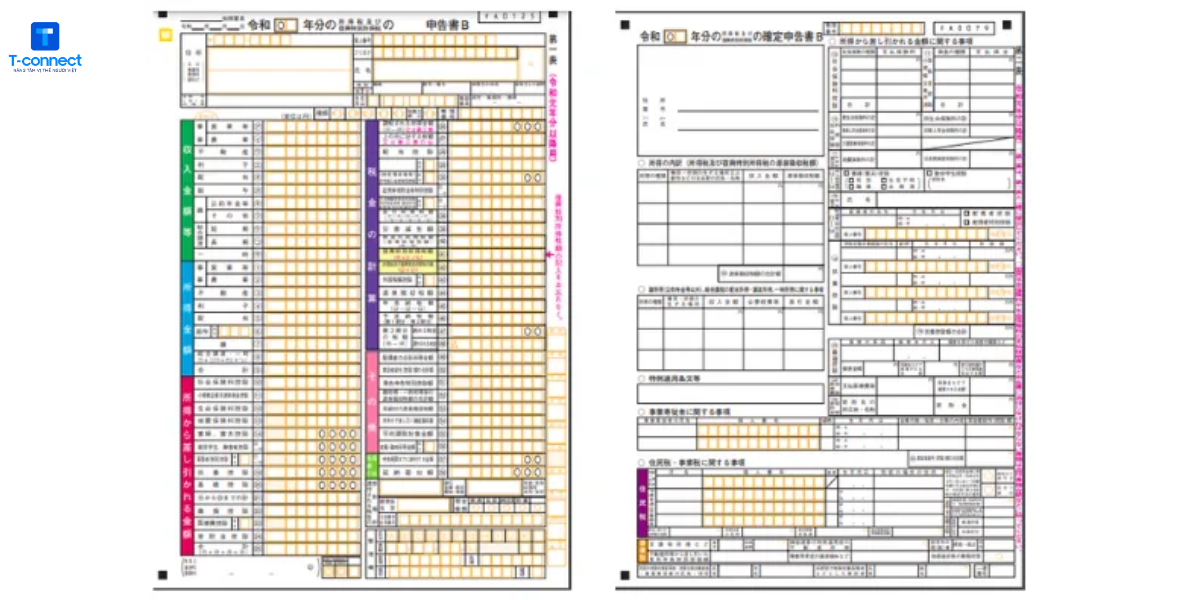
Step 2: Fill out the tax declaration (確定申告書 – Kakutei Shinkoku)
There are 2 ways to fill out a tax return:
- Online via e-Tax system: for people with My Number card and IC reader.
- Fill in by hand or computer and print out: download sample at here.
Content to be filled in includes:
- Personal information (full name, address, My Number…).
- Income, tax deducted (based on Gensen Choshuhyo).
- Dependent declaration section if any (clearly state relationship, nationality, year of birth).
- Bank account information to receive refund.
You should check each number carefully, fill it clearly in capital letters, do not use Japanese abbreviations.
Step 3: Submit application to tax office (税務署 – Zeimusho)
You can:
- Go directly to the tax office at your residential address.
- Send documents by post (preferably registered mail).
- Submit online using e-Tax (if you have enough equipment and electronic signature).
Step 4: Wait for confirmation from tax authorities
After submitting the application, the tax officer can:
- Call to request additional documents if there are any deficiencies.
- Send confirmation letter or tax refund notice to registered address.
Processing time is usually 1 to 2 months, depending on the area and number of applications.
Step 5: Receive tax refund into your account
If your application is valid, you will receive a refund:
- Transfer directly to the Japanese bank account declared in the application form.
- No need to come in person or re-sign documents.
Refund amounts can range from a few thousand yen to several million, depending on income level, number of dependents, and amount of tax withheld.
Important notes when applying for tax refund in Japan
When carrying out tax refund procedures in Japan, whether you do it yourself or through a support service, you still need to clearly understand the important notes below to avoid mistakes, tax refund rejection or penalties:
- Do not falsely declare dependents: If discovered, you may be subject to tax refunds, administrative fines, and even visa restrictions.
- Only one dependent can be claimed per person: If multiple people are providing support, agree that only one person should be named to avoid having their tax refund denied.
- Tax refunds are only available within the last 5 years: After 5 years, you are no longer entitled to claim a refund for that year.
- Apply early to avoid peak season: Even though the deadline is mid-March, you should submit it in early February for quick processing and to avoid waiting.
- Incomplete or unclear documents may be returned: The tax authority has the right to request additional information or refuse if the documents are incomplete or incorrect.
- Always keep a copy of your submitted documents: Helps you with future reference, especially if you want to claim dependents annually.
- Tax refund is still possible when returning home: You can authorize a relative or service in Japan to do it for you if you are no longer in Japan.
- Be careful when hiring a declaration service: Choose a reputable place, avoid "underground" services that have the risk of false declaration or high fees without transparency.
Tax refund in Japan is a legitimate and legal right that any Vietnamese living, studying or working in Japan should be aware of. Just understand the correct procedure, prepare all the documents to apply for a tax refund in Japan and follow the correct personal income tax refund procedures, you can completely do it yourself and receive a not small amount of money back. Please save this article from T-connect Make this guide every year, or share it with friends and relatives who also need a tax refund in Japan!

T-connect & DCOM signed a cooperation agreement to enhance digital experiences for the Vietnamese user community in Japan.
On November 17, 2025, T-connect & DCOM officially signed a [...]
ANSWERS TO FREQUENTLY ASKED QUESTIONS WHEN PAYING FOR MY T-CONNECT WITH DCOMPAY
T-Connect officially cooperates with DCOM, launching DCOMPay payment method [...]
T-CONNECT CUP 2025 FOOTBALL TOURNAMENT REGULATIONS – CELEBRATION OF T-CONNECT'S 6TH ANNIVERSARY
The T-connect Cup 2025 football tournament is one of the sporting events [...]
Should I stay in Japan or return to Vietnam? 5 perspectives to help you make the right choice
After many years of studying and working in Japan, many people [...]
Which apps should Vietnamese people in Japan download? 15 essential apps when in Japan
Living, studying or working in Japan always comes with many [...]
5 tips to ship goods from Vietnam to Japan cheaply and safely
The demand for shipping goods from Vietnam to Japan is increasing, especially [...]
What do you need to prepare when converting your Japanese driver's license to Vietnam's? 7 important documents
While living and studying in Japan, many Vietnamese people have [...]
How does Japan handle waste? 5 waste treatment technologies in Japan that surprise the world
Japan is known as a country with a waste management system [...]