
 Home
Home About
About Product
 News
News  Media channels
 Guide
GuideJob change address in japan is a mandatory administrative procedure if you move house, whether within the same city or to another province. If you do not notify the local authorities on time, you may be fined or have your rights such as insurance, taxes, postal services, etc. affected. Don't worry if you are not good at Japanese, in this article, T-Connect will guide you through each specific and easy-to-understand step to complete the procedure quickly.

When do I need to change my address in Japan?
When living in Japan, changing your address is a mandatory administrative procedure every time you move. Whether you move within the same area or to another prefecture, you must notify the local government on time to update your personal information and avoid legal trouble. Below are the cases where you need to carry out the address change procedure in Japan:
- Moving within the same city/district: You still have to notify the administrative office to update your new address on your residence card and related documents.
- Moving to another city or province: It is mandatory to make a moving out document at the old place and a moving in document at the new place to avoid fines or visa effects.
- Moving abroad (returning home, changing nationality…): It is necessary to declare moving out of Japan to stop obligations related to tax and insurance.
- Whole family/collective household registration transfer: Even if you are only a dependent, you still have to do separate procedures if your name is on the residence card.
- Temporary but long-term moves (over 90 days): Some localities still require declaration if you have lived at the new address for a long time even though you have not terminated the old housing contract.
The procedure for changing address in Japan should be completed within 14 days of moving to the new address to avoid administrative penalties.
>> Read more: How to change address in Japan 2025: Simple, fast, no worries about missing anything!
What documents are required to change address in Japan?
To change your address in Japan, you need to prepare some required documents to submit to the administrative office (市役所 or 区役所). Being fully prepared will save you time and avoid having to go back and forth multiple times. The documents you need to prepare for the address change procedure in Japan include:
- Residence card (在留カード – Zairyuu Card): Must bring along to update new address directly on card.
- Transfer certificate (転出証明書 – Tenshutsu Shoumeisho): Issued when you declare your move if you move to another city/province.
- My Number Card (My Number Card) or My Number Notification Paper: Required to update new address to personal number management system.
- Other identification documents (if any): Passport, driver's license, etc. may be required for further verification.
- National insurance book (国民健康保険証 – Kokumin Kenkou Hokenshou): If you use national insurance, you need to update your new address.
- Dependent registration certificate (if any): In case you declare for your whole family or relatives.
- New rental agreement or new residence confirmation: Some localities require confirmation of actual residence to complete the procedure.
7 Step Guide to Changing Address in Japan
The procedure for changing your address in Japan can be confusing if you are not familiar with Japanese administration or do not speak the language. However, if you understand the process correctly and prepare the necessary documents, you can do it yourself in less than 1 hour. Let T-Connect guide you through 7 detailed steps to help you complete the address change quickly and legally:
Step 1: Declare move
Before leaving your old residence, you need to go to the ward office (区役所・市役所) in your current locality to fill out a moving-out form – 転出届 (tenshutsu todoke). After submitting it, you will be issued a moving-out certificate – 転出証明書 (tenshutsu shoumeisho).
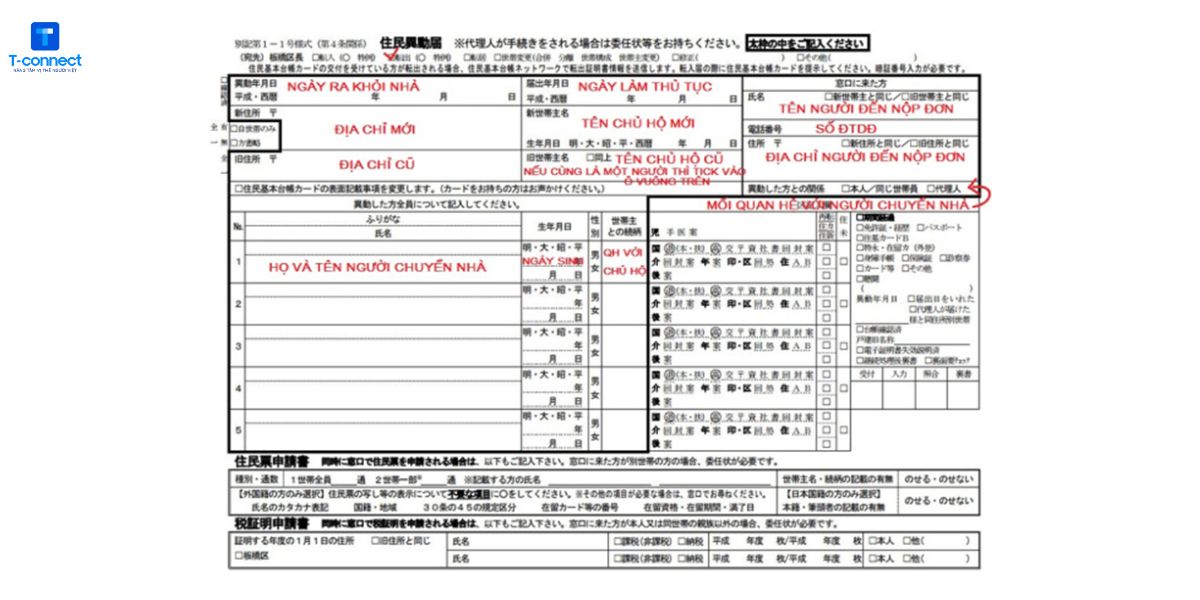
Step 2: Prepare all necessary documents
Before moving to your new home, please have the following documents ready:
- Thẻ cư trú (residence card)
- My Number Card or Individual Number Notification
- Transfer papers (if any)
- Passport or ID
- National insurance book (if participating)
- New rental agreement or proof of residence
After moving to a new address, you must go to the administrative office in the new area within 14 days to complete the moving-in procedure – 転入届 (tennyuu todoke).
Step 3: Declare move to new residence
You will need to provide:
- Transfer papers (if any)
- New address
- Move in date
- Information about people living together (if any)
Step 4: Receive your residence card with updated address
After receiving the information, the administrative officer will affix a new address label to the back of your residence card. This is a mandatory step to confirm your new legal residence in Japan.
Step 5: Update information on My Number card
If you have a physical My Number card (IC chip), the staff will update it directly on the chip or back of the card.
If you only have your My Number notification, they can print a new confirmation.Step 6: Re-register for public services (if necessary)
At the administrative office, if you are registered for national health insurance (国民健康保険) or child allowance, please update your information immediately. The staff will guide you to fill out a separate form to continue receiving these benefits.
Step 7: Update address with other services
Once you have legally changed your address, you will need to update other relevant parties, including:
- Post office: Sign up for mail forwarding service – 転送届 (tensou todoke)
- Bank: Change address to receive mail, pin, statement
- Phone/Internet Carrier: Update payment and contract information
- Workplace, school: Notification to update personal profile
- Online platforms (Amazon, Rakuten…): Avoid lost goods
Some important notes when changing address in Japan
Job change address in japan It seems like a simple administrative procedure, but if not done correctly and on time, you can get into a lot of trouble, from losing important mail to the risk of breaking the law. Some important notes that you should know to ensure the process of changing address goes smoothly and legally include:
- Must be declared within 14 days of moving: If you are late, you may be subject to administrative penalties and affect visa or insurance procedures.
- No moving papers required if moving within the same city/district: In this case, you only need to make a transfer paper at the administrative office of the new place of residence.
- Should go in the morning or midweek: Avoid peak times like lunchtime or the end of the day to save time waiting in line.
- Write down the information if you don't know Japanese: Preparing in advance makes it easier for you to communicate with administrative staff and fill out applications quickly.
- Remember to bring original documents, not just photocopies: Many places do not accept copies so bring the original for comparison.
- Register for mail forwarding at the post office immediately after moving: Make sure you don't miss important mail sent to your old address during the initial move.
- Notify companies, schools, and service providers immediately after updating your address: Helps synchronize information, avoid loss of communication or service interruption.
Job change address Japan is a mandatory procedure but not too difficult if you understand the process and prepare all the necessary documents. Whether you are just moving within the same city or to another province, remember to make a timely declaration, update information at relevant agencies and proactively change the address in personal services to avoid future troubles.

T-connect & DCOM signed a cooperation agreement to enhance digital experiences for the Vietnamese user community in Japan.
On November 17, 2025, T-connect & DCOM officially signed a [...]
ANSWERS TO FREQUENTLY ASKED QUESTIONS WHEN PAYING FOR MY T-CONNECT WITH DCOMPAY
T-Connect officially cooperates with DCOM, launching DCOMPay payment method [...]
T-CONNECT CUP 2025 FOOTBALL TOURNAMENT REGULATIONS – CELEBRATION OF T-CONNECT'S 6TH ANNIVERSARY
The T-connect Cup 2025 football tournament is one of the sporting events [...]
Should I stay in Japan or return to Vietnam? 5 perspectives to help you make the right choice
After many years of studying and working in Japan, many people [...]
Which apps should Vietnamese people in Japan download? 15 essential apps when in Japan
Living, studying or working in Japan always comes with many [...]
5 tips to ship goods from Vietnam to Japan cheaply and safely
The demand for shipping goods from Vietnam to Japan is increasing, especially [...]
What do you need to prepare when converting your Japanese driver's license to Vietnam's? 7 important documents
While living and studying in Japan, many Vietnamese people have [...]
How does Japan handle waste? 5 waste treatment technologies in Japan that surprise the world
Japan is known as a country with a waste management system [...]